
The Central Board of Trustees approved five sweeping reforms at its 238th meeting in October 2025, all aimed at balancing easier access to funds with stronger retirement security. PF withdrawal rules will be more simpler and easy to comprehend.
These reforms are expected to be introduced in its application software from July 2026.
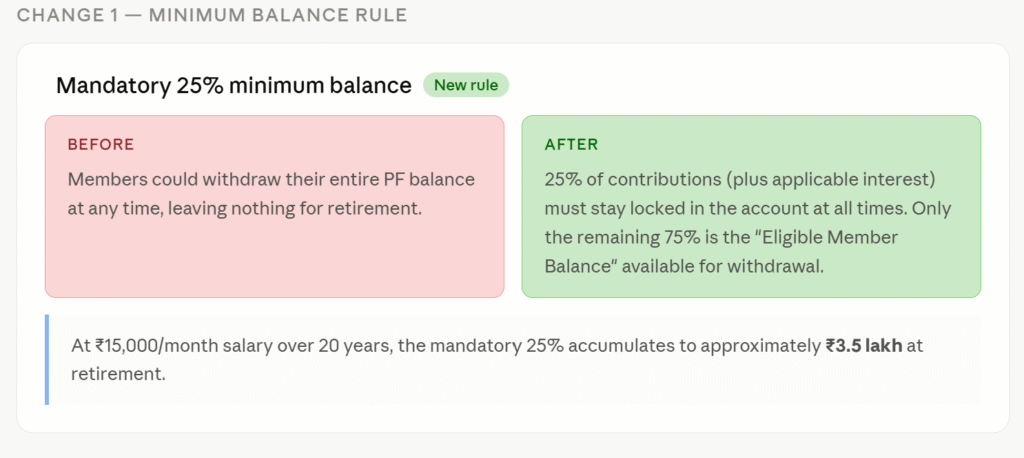
The biggest structural change is a mandatory 25% minimum balance — a first for the EPF scheme. From now on, no matter what you withdraw for, a quarter of your contributions (plus earned interest) must stay put in your account. Think of it as a forced retirement pot the system protects on your behalf.
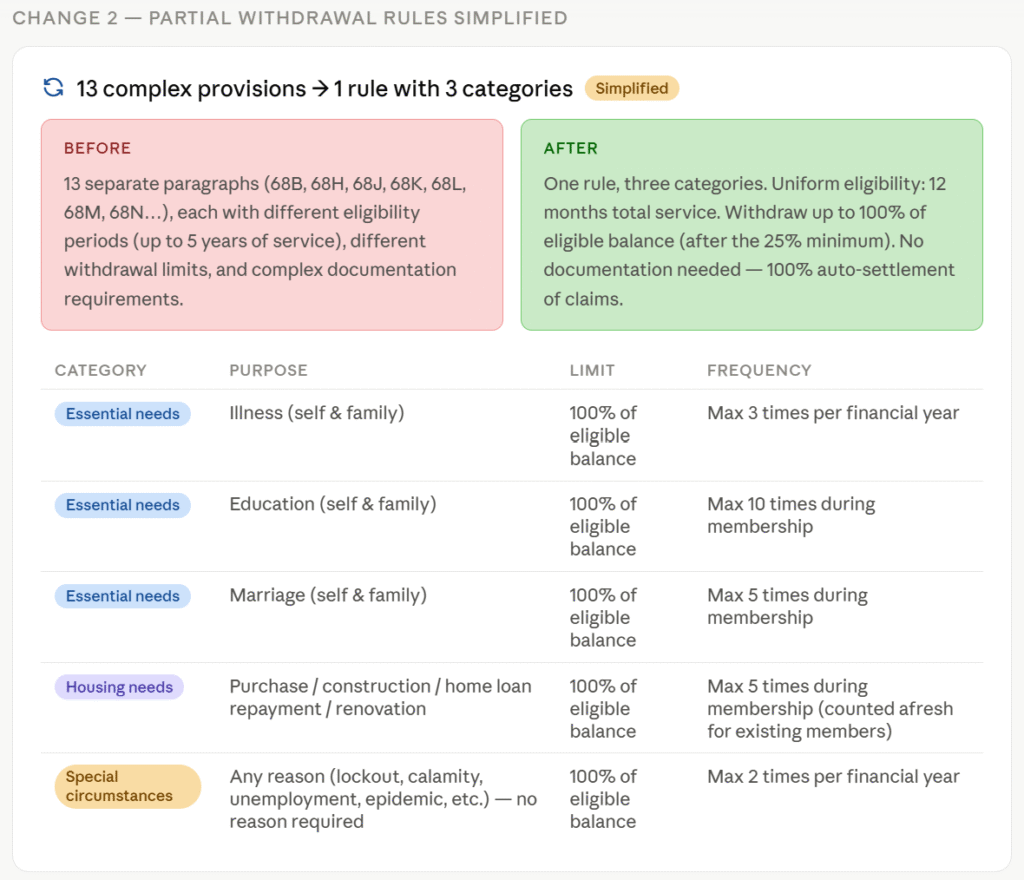
On the flip side, withdrawals have never been easier. The old maze of 13 different paragraphs — each with its own service requirements, caps, and paperwork — has been collapsed into three simple categories: Essential Needs, Housing, and Special Circumstances. You only need 12 months of total service (down from up to 5 years) and can withdraw up to 100% of your eligible balance without any documentation, fully automated making PF withdrawals simplified.
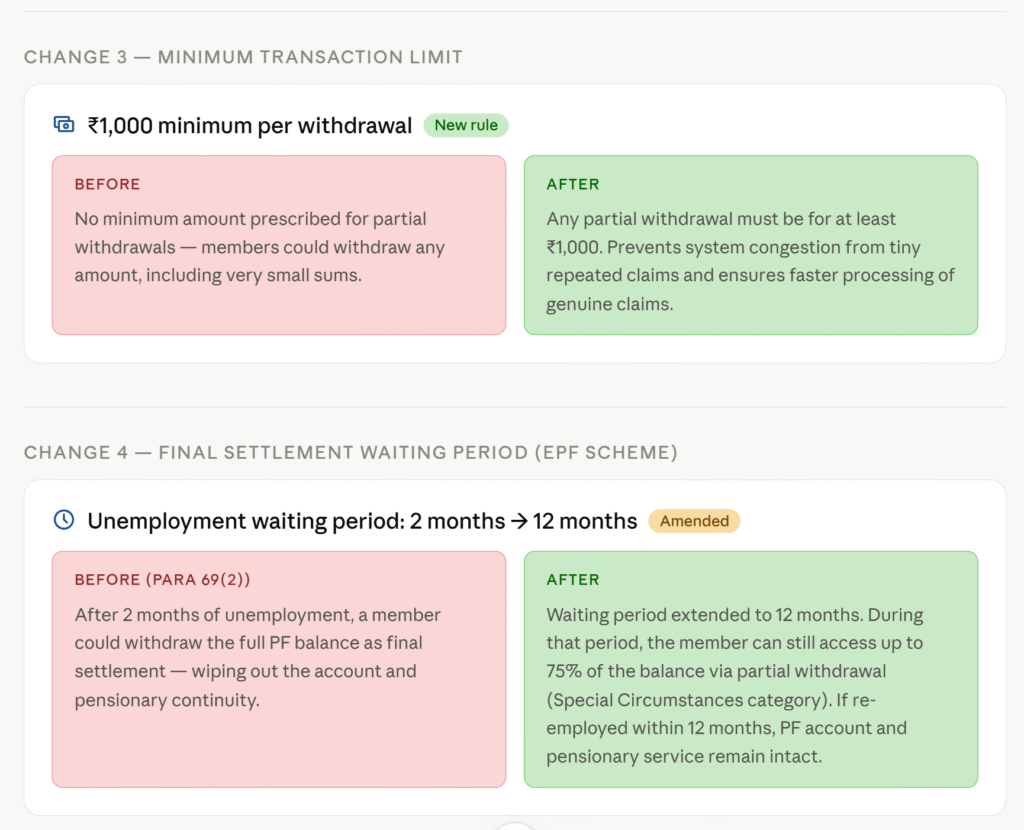
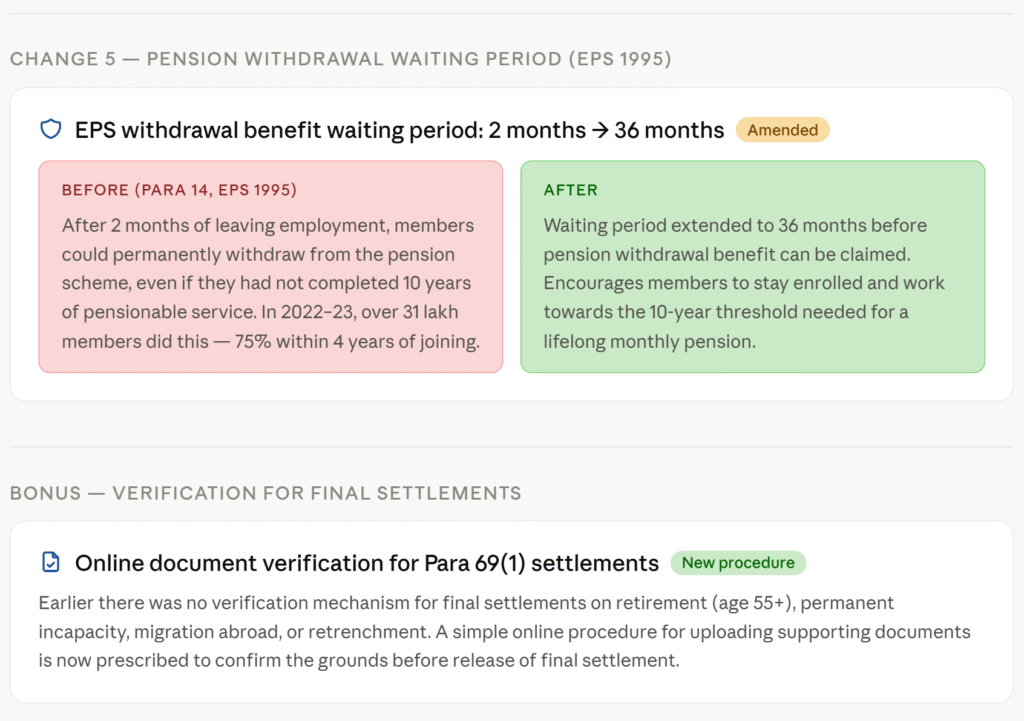
To discourage premature account closures or PF withdrawals, the unemployment waiting period before final settlement is extended from 2 months to 12 months under EPF, and from 2 months to a full 36 months under EPS 1995 — giving members time to find new employment while keeping their pension clock running.
EPFO reforms — 238th CBT, October 2025
Five major changes approved by the Central Board of Trustees
The reforms proposed by the Central Board of Trustees (CBT) have naturally invited debate, and differing opinions are an integral part of any significant policy change. However, when these reforms are viewed in their entirety and with a long-term perspective, it becomes evident that they are fundamentally designed to strengthen the social security framework for EPF members rather than dilute their benefits.
A key concern raised relates to the proposal of increasing the waiting period for withdrawal of the EPS Withdrawal Benefit from 2 months to 36 months. At first glance, this may appear restrictive. In reality, it serves as an important safeguard for members and their families. If a member unfortunately passes away during this 36-month period—even while not in employment—the family remains eligible for widow/widower pension and children pension under the Employees’ Pension Scheme. This protection is virtually the same as the benefit available in the event of death while in service. Had the member withdrawn the EPS benefit immediately after two months of unemployment, these valuable lifelong family pension benefits would have been permanently lost.
Similarly, the proposal to retain a minimum balance of 25% in the EPF account is not intended to curtail access to savings. Instead, it ensures that every member accumulates a meaningful retirement corpus, continues to earn EPFO’s attractive annual interest with the benefit of compounding, and enjoys greater financial security in old age. At the same time, members are given much easier access to the remaining eligible balance through simplified withdrawal provisions.
The simplification of 13 complex withdrawal rules into just three easy-to-understand categories, the reduction of service eligibility to 12 months, the move towards 100% automated claim settlement, and the elimination of cumbersome documentation are all clear indicators that the reforms prioritize ease of living for members while preserving their long-term financial interests.
Every reform may attract criticism when viewed in isolation. However, public policy should be evaluated not merely on immediate convenience but on its ability to provide lasting financial protection. These proposals strike a thoughtful balance between meeting members’ present-day financial needs and safeguarding their retirement and family security. On the whole, the reforms represent a progressive, employee-centric approach that strengthens social security, simplifies compliance, and ensures that EPF and EPS continue to serve their primary purpose—providing dignity, stability, and financial security to workers and their families throughout their lives.